

History of Baccarat: From 15th Century Italy to Global Casino Floors
A game born in the private salons of Italian aristocrats now generates more casino revenue in Macau than every slot machine on the Las Vegas Strip combined. The history of baccarat stretches over 500 years, crossing borders, surviving prohibition, weathering scandals, and reinventing itself at every stop. It started as a card game for nobles who had more money than patience.
It became the obsession of French kings. It crossed the Atlantic hidden in the luggage of European immigrants. And by the 21st century, it quietly became the highest-grossing table game on the planet. Most players sit down without knowing any of this. That’s a shame, because the story behind the cards is almost as interesting as the game itself.
- Baccarat originated in 15th century Italy under the name “baccara,” meaning zero, a reference to the value of face cards
- The game split into two major variants in France: Chemin de Fer (player-banked) and Baccarat Banque (fixed banker)
- Punto Banco, the version played in virtually every casino today, was developed in Argentina in the 1950s
- The 1891 Tranby Croft scandal nearly destroyed baccarat’s reputation in England when the Prince of Wales was called to testify
- Macau’s baccarat tables generate more revenue than the entire Las Vegas Strip, making it the world’s most profitable casino game
- James Bond originally played baccarat (Chemin de Fer), not poker, establishing the game’s cinematic identity
The Italian Origins: 1400s
The story begins in Italy. The exact year is debated by historians, but most agree baccarat first appeared in the 1400s. The name comes from the Italian word “baccara,” meaning zero. Face cards and tens are worth zero in baccarat, and the worst possible hand is also zero. The Italians named the game after its least desirable outcome. There’s a bleak poetry to that.
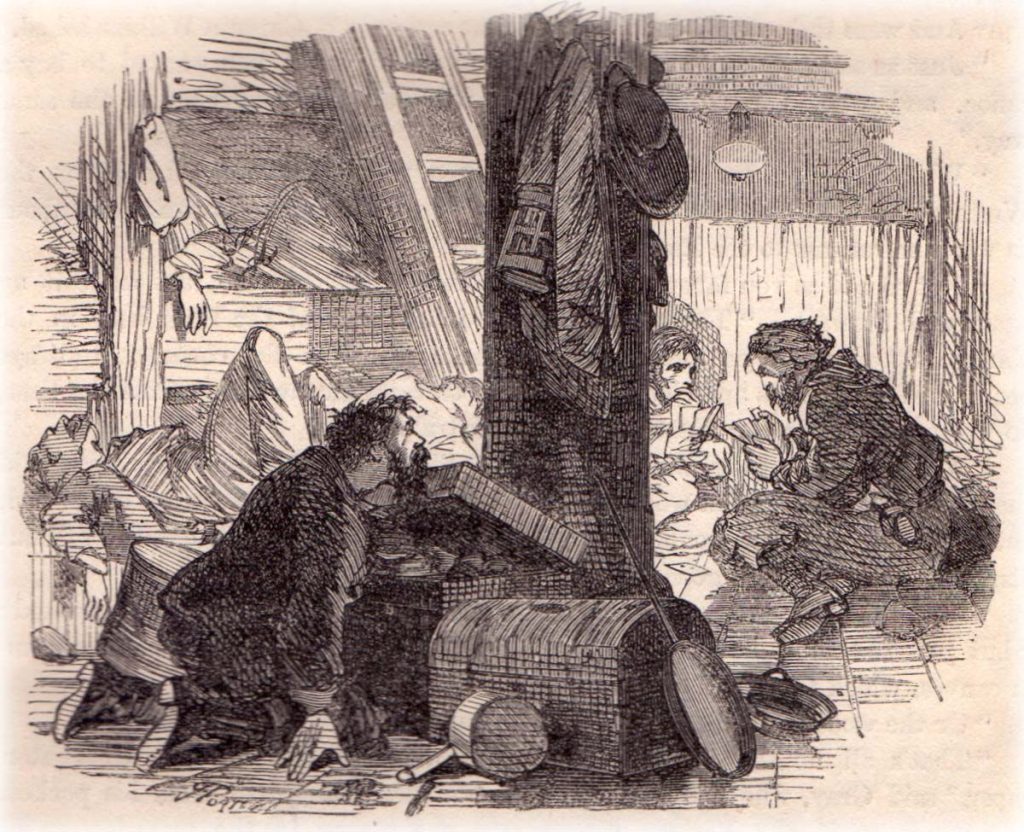
Early baccarat was played with tarot cards, though it soon transitioned to standard playing cards. The game was a favorite among Italian aristocrats, who played it in private salons far from public view. Gambling was technically illegal in many Italian city-states during this period, but laws rarely applied evenly to the wealthy. Baccarat thrived behind closed doors.
One persistent legend credits a man named Felix Falguiere (sometimes spelled Falguierein) with inventing the game. Some accounts tie baccarat to an ancient Etruscan ritual involving a nine-sided die and a virgin priestess. That story is almost certainly mythology, but it illustrates how the game’s origins have been romanticized over centuries. What we know for certain: by the late 1400s, baccarat was an established card game among the Italian upper class, and it was about to cross the Alps.
France and the Birth of Two Variants: 1490s to 1800s
Baccarat crossed into France in the late 1490s, likely brought by soldiers returning from the Italian Wars under King Charles VIII. France embraced the game with an enthusiasm that would shape its identity for the next 300 years.
Chemin de Fer
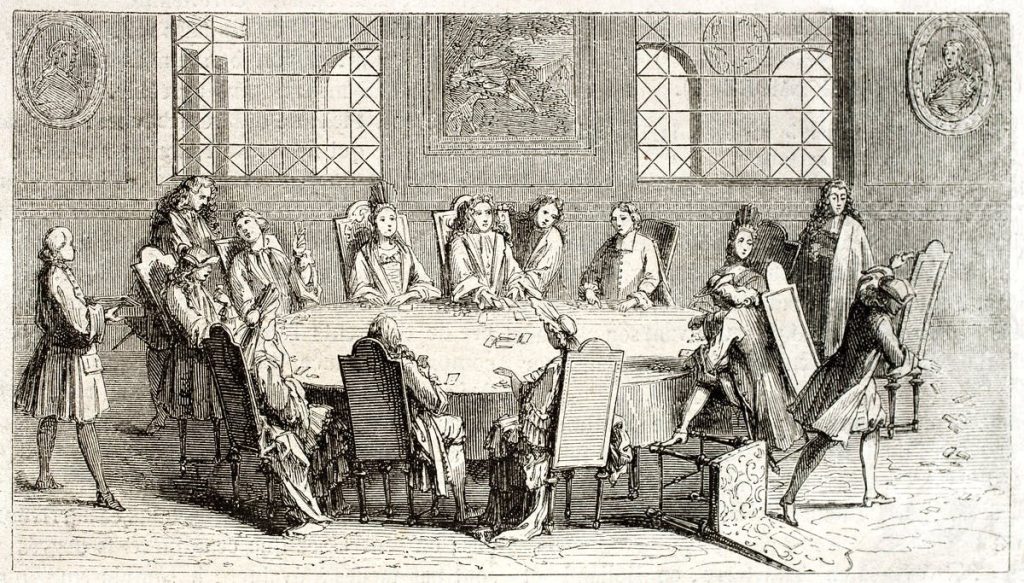
The French developed their own version called Chemin de Fer (French for “railway,” a reference to the shoe traveling around the table like a train). In Chemin de Fer, players take turns acting as the banker. The current banker deals, and other players bet against them. Critically, both the player and banker can make decisions about drawing a third card. This is the version where skill actually matters, the version that would later appear in the original James Bond novels.
Baccarat Banque
A second variant, Baccarat Banque (also called “à deux tableaux,” meaning “two tables”), emerged around the same time. In this version, the banker position is fixed rather than rotating. The banker plays against two Player hands simultaneously, one on each side of the table. Baccarat Banque required a larger bankroll to hold the banker position, which made it the preferred game of the extremely wealthy.
Royal Patronage and Legal Trouble
By the reign of King Louis XIV (1643 to 1715), baccarat had become the card game of the French court. Nobles played for staggering sums. The game’s association with royalty cemented its reputation as the most prestigious gambling pursuit in Europe.
Then the French government banned gambling in 1837. Baccarat didn’t disappear. It simply moved underground. Private clubs in Paris continued to host games, and the prohibition arguably increased the game’s mystique. When France legalized casino gambling again in 1907, baccarat was among the first games to return to the felt.
The Tranby Croft Scandal: 1891
No history of baccarat is complete without the Tranby Croft affair. It’s the scandal that nearly killed the game in England and dragged the future King of England into court.
In September 1890, a group of wealthy guests gathered at Tranby Croft, a Yorkshire estate owned by shipping magnate Arthur Wilson. Among the guests was Albert Edward, the Prince of Wales (later King Edward VII), an avid baccarat player. The group played baccarat after dinner, which was technically illegal in England at the time.

During the game, several guests accused Sir William Gordon-Cumming, a decorated military officer, of cheating by manipulating his bets after seeing the cards. Gordon-Cumming denied the allegations. To avoid a public scandal, the other guests asked him to sign a document promising never to play cards again, in exchange for their silence.
The silence didn’t hold. Word leaked, and Gordon-Cumming sued five of the guests for slander. The trial became a national sensation. The Prince of Wales was called as a witness. The British press went wild. Gordon-Cumming lost the case and was expelled from the army and London society. The prince escaped legal consequences but suffered enormous public embarrassment.
The Tranby Croft scandal exposed baccarat’s underground popularity in England and reinforced its image as a game of the privileged. It also demonstrated something that remains true today: baccarat and high-stakes drama are never far apart.
Baccarat Crosses the Atlantic: 1900s to 1950s
Baccarat arrived in America in the early 20th century, but it didn’t exactly receive a warm welcome. American gamblers preferred craps, blackjack, and poker. Baccarat felt foreign, elitist, and unnecessarily complicated (the Chemin de Fer version was what most Americans first encountered).

The game struggled to gain traction in Las Vegas casinos through the 1930s and 1940s. Casino operators tried various formats, but none caught on with the mainstream American gambler. The turning point came from an unexpected place: Argentina.
The Punto Banco Revolution
In the 1950s, an Argentine casino developed a simplified version of baccarat called Punto Banco. The breakthrough was simple but profound: all drawing decisions were removed. The tableau (the set of rules governing third card draws) became automatic. No player choices. No skill decisions. You bet on Player, Banker, or Tie, and the dealer handles everything.
Tommy Renzoni, a gambling writer and casino employee, brought Punto Banco from Havana, Cuba (where it had migrated from Argentina) to the Sands Hotel in Las Vegas in 1959. This is the version that stuck. It’s the version you’ll find in every casino today when someone says “baccarat.”
The elimination of player decisions did two things. It made the game faster, which casinos loved. And it made the game accessible to anyone who could point at a betting circle, which players loved. If you want to understand how the modern rules work, our guide to baccarat terminology covers every term from “coup” to “natural.”
The Rat Pack Era and Vegas Glamour: 1960s to 1980s
Once Punto Banco landed in Las Vegas, baccarat found its identity in America: exclusive, roped-off, and reserved for the biggest spenders.
Las Vegas casinos deliberately cultivated this image. Baccarat tables were placed in separate rooms, often behind velvet ropes. Minimum bets were set high, typically $20 to $100 (in 1960s dollars, the equivalent of $200 to $1,000 today). Dealers wore tuxedos. The atmosphere screamed “you need to be somebody to play here.”
The Rat Pack era amplified this mystique. Frank Sinatra, Dean Martin, and their circle frequented Las Vegas, and the glamour of the era rubbed off on every game in the house. Baccarat, with its European pedigree and exclusive presentation, fit perfectly into the narrative of Vegas sophistication.
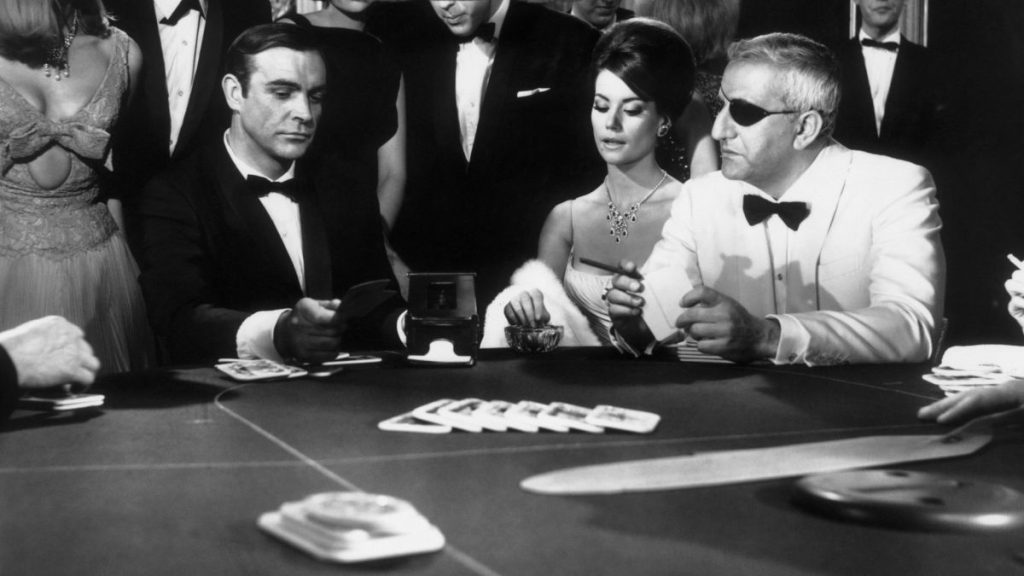
Then came James Bond. Ian Fleming’s original novels featured Bond playing Chemin de Fer, most famously in “Casino Royale” (1953). The 1962 film “Dr. No” included a baccarat scene that introduced millions of moviegoers to the game. Bond didn’t play poker in the books. He played baccarat. That association between baccarat and suave, high-stakes cool persisted for decades and still influences how people perceive the game. Our full breakdown of baccarat in pop culture covers every major appearance.
During this period, baccarat accounted for a small but wildly profitable slice of Las Vegas revenue. The average bet size dwarfed every other table game. High-rollers from around the world flew in specifically to play baccarat, and casinos treated them like royalty in return.
The Macau Explosion: 1990s to Present
If Las Vegas made baccarat glamorous, Macau made it gargantuan.
When Portugal handed sovereignty of Macau back to China in 1999, the former colony was already a gambling hub. But the liberalization of casino licenses in 2002 ignited an explosion. International casino operators, including Las Vegas Sands, Wynn, and MGM, poured billions into new properties. And the game that filled those properties was baccarat.

By 2026, baccarat accounts for roughly 80% to 90% of all table game revenue in Macau. That’s not a typo. In a market that generates tens of billions of dollars annually, baccarat is responsible for the vast majority of it. The game resonates deeply with Chinese culture for several reasons: the number 8 (the best possible hand) is considered extremely lucky in Chinese tradition, the superstitions around card rituals add a personal element, and the quick pace suits players who want action without lengthy decision-making.
Macau’s baccarat scene operates on a scale that dwarfs anything in the West. Tables with $500,000 maximum bets exist. Private rooms (called “junket rooms”) cater to VIP players who gamble millions per trip. The average bet size at a Macau baccarat table is many multiples of what you’d see in Las Vegas.
This dominance has reshaped the global casino industry. New casino resorts in Singapore, the Philippines, South Korea, and Australia all prioritize baccarat floor space. The game that European nobility played in private salons 500 years ago now drives the economics of a multi-billion dollar international industry.
| Era | Location | Key Development | Variant Played |
|---|---|---|---|
| 1400s | Italy | Game invented among aristocrats | Original baccara |
| 1490s | France | Adopted by French court | Chemin de Fer, Baccarat Banque |
| 1800s | England | Punto Banco simplification begins | Early Punto Banco |
| 1891 | England | Tranby Croft cheating scandal | Chemin de Fer |
| 1950s | Argentina / Cuba | Punto Banco finalized, all decisions removed | Punto Banco |
| 1959 | Las Vegas | Tommy Renzoni brings Punto Banco to the Sands | Punto Banco |
| 1962 | Hollywood | James Bond plays baccarat in “Dr. No” | Chemin de Fer |
| 2002+ | Macau | Casino liberalization; baccarat dominates | Punto Banco |
Famous Baccarat Players and Legendary Sessions
The game’s history is studded with characters who pushed baccarat to its limits, sometimes winning fortunes, sometimes losing them, and occasionally getting sued in the process.
Akio Kashiwagi, a Japanese real estate developer, was perhaps the most famous baccarat high-roller of the 20th century. In 1990, he played a marathon session at the Trump Taj Mahal in Atlantic City. He started with $12 million and, over the course of several days, won $6 million before eventually losing $10 million in subsequent sessions. Kashiwagi was murdered in 1992, and the case remains unsolved.
Kerry Packer, the Australian media mogul, was legendary for his baccarat sessions. He reportedly won between $20 million and $40 million in a single session at the MGM Grand in Las Vegas. He was also known for tipping generously, once leaving a $1 million tip for a group of dealers. Packer played baccarat the way most people play quarter slots: with absolute disregard for the amounts involved.
Phil Ivey, the poker champion, made headlines for a different reason. In 2012, he won approximately $9.6 million at Crockfords Casino in London using a technique called edge sorting. The casino refused to pay, and the resulting legal battle went to the UK Supreme Court, which ruled in the casino’s favor. Ivey also won $10 million at Borgata in Atlantic City using the same technique, and a US court ordered him to return the money. Our article on famous baccarat players and their strategies covers more of these stories.
How the Variants Evolved
Understanding how baccarat splintered into different versions helps you make sense of what you’ll find at casinos in 2026.
Punto Banco dominates globally. Every drawing decision is automatic. The house banks every hand. You bet on Player, Banker, or Tie. That’s it. The Banker bet carries a 1.06% house edge; the Player bet sits at 1.24%. The simplicity is the entire point.
Chemin de Fer survives in a handful of European casinos. Players take turns as the banker, bet against each other (not the house), and make drawing decisions. It’s more social, more strategic, and far slower than Punto Banco.
Baccarat Banque is nearly extinct. A fixed banker plays two Player hands simultaneously. You’d need to visit a high-end European gaming club to find one.
Mini-Baccarat is Punto Banco played on a smaller table (7 seats instead of 12 to 14) with lower minimums and a single dealer. It’s the most accessible format and the one you’ll encounter most often on regular casino floors. The rules are identical to big-table Punto Banco.
Super 6 (also called EZ Baccarat) removes the 5% commission on Banker wins but pays 0.5:1 when Banker wins with a total of 6. It’s a modern variant designed to speed up gameplay by eliminating commission tracking.
| Variant | Player Decisions? | Banker Role | Where You’ll Find It |
|---|---|---|---|
| Punto Banco | No | House-banked | Everywhere globally |
| Chemin de Fer | Yes | Rotates among players | Select European casinos |
| Baccarat Banque | Yes (limited) | Fixed (one player) | Very rare; European clubs |
| Mini-Baccarat | No | House-banked | Most casino main floors |
| Super 6 / EZ Baccarat | No | House-banked (no commission) | Growing in availability |
Myths and Misconceptions Through the Centuries
Baccarat has accumulated more myths per square foot of felt than any other casino game. Some of these misconceptions are harmless. Others cost people real money.
The biggest myth: baccarat is a game for the rich. It was, 400 years ago. It isn’t anymore. Mini-baccarat tables on any casino floor accept $10 bets. Online baccarat goes even lower. The game’s rules are identical whether you bet $5 or $500,000.
The second myth: baccarat requires skill. Standard Punto Banco requires zero skill. You make one decision (where to place your bet), and then the rules play themselves out automatically. The only “skill” is choosing Banker over Tie, and even that is just knowing one number (1.06%) is better than another (14.36%).
The third myth: patterns in the baccarat roads predict future outcomes. Every coup is independent. The Big Road, Bead Plate, and derived roads are historical records, not crystal balls. They’re fun to watch and deeply embedded in baccarat culture, but they don’t change the math.
And the persistent myth about card counting in baccarat: yes, it’s theoretically possible, but the edge it provides is so minuscule that it’s practically worthless. The shoes are too large (8 decks) and the advantage per bet is too small to make it profitable. Blackjack counting works because removing certain cards dramatically shifts the odds. Baccarat counting doesn’t produce that same effect.
Where Baccarat Stands in 2026
Five centuries after Italian aristocrats shuffled tarot cards in candlelit rooms, baccarat is the most profitable table game on the planet. Its journey through royal courts, illegal gambling halls, Hollywood films, and Asian mega-casinos is a story of constant reinvention without losing the game’s core identity.
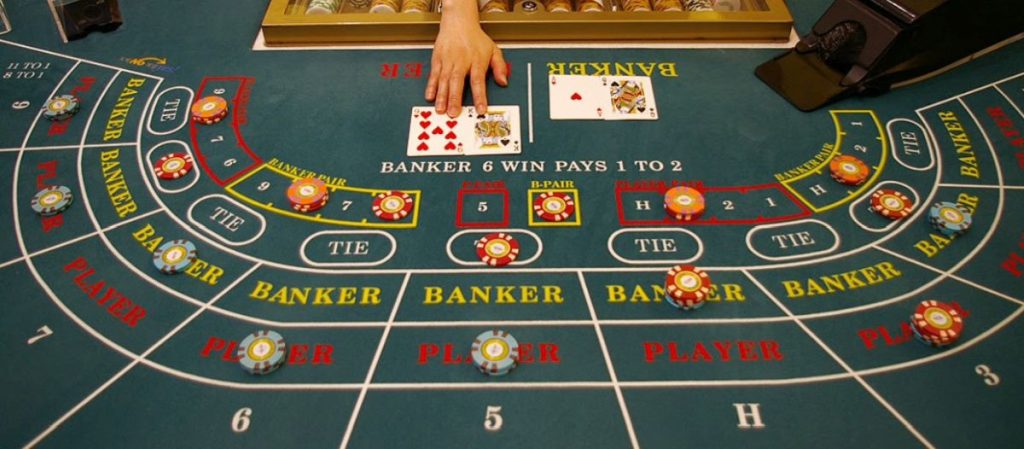
The version you play today, Punto Banco, is the simplest baccarat has ever been. Three bets. Automatic drawing rules. A Banker house edge of 1.06% that makes it one of the best wagers available in any casino. You can try it right now on our free baccarat simulator without spending a cent, playing the same game that kings once fought over and billionaires still chase.
What hasn’t changed in 500 years is the feeling at the table. The anticipation as cards are turned. The crowd leaning in when a big bet is riding. The rush of a natural 9. Baccarat earned its place in history, and it shows no signs of giving it up.
History of Baccarat FAQs
Baccarat originated in Italy during the 1400s. The exact year is unknown, but historical records place the game among Italian aristocrats by the mid-15th century. The name comes from the Italian word “baccara,” meaning zero, a reference to the value of face cards and tens.
The inventor is not definitively known. Some sources credit Felix Falguiere (or Falguierein), an Italian gambler, but this attribution is not confirmed. What is established is that the game emerged among Italian nobility in the 1400s and spread to France by the late 1490s.
Chemin de Fer is the older French version where players take turns as banker and make decisions about drawing a third card. Punto Banco, developed in Argentina in the 1950s, removes all player decisions. Drawing rules are automatic, and the house banks every hand. Punto Banco is the version played in virtually every casino in [current_year]. For a full comparison, see our variations of baccarat guide.
Several cultural factors drive baccarat’s dominance in Macau. The number 8, the best possible hand, is considered extremely lucky in Chinese culture. Superstitious rituals like the squeeze add a personal element. The game’s fast pace appeals to high-volume players, and VIP junket rooms accommodate bettors wagering millions per trip.
In 1891, a group of English aristocrats accused Sir William Gordon-Cumming of cheating at baccarat during a private party attended by the Prince of Wales (future King Edward VII). The resulting trial became a national sensation, with the prince called as a witness. Gordon-Cumming lost the slander case and was exiled from society.
In Ian Fleming’s original novels, James Bond played Chemin de Fer (a variant of baccarat). The 1962 film “Dr. No” featured Bond at a baccarat table. The switch to Texas Hold’em poker occurred in the 2006 film “Casino Royale,” reflecting poker’s mainstream popularity at the time. For more on baccarat’s cinematic history, see our pop culture article.